

MASTERCLASSES 2027: Barolo and Barbaresco vs. Alto Piemontese DOCGs and DOCs
A few key notes from the past few days that have come my way…
If you want to buy a vineyard in the Barolo region, you’ll have to pay 2.3 million per hectare.
Climatic issues are leading more and more wineries to be built underground, either entirely or partially. Let’s not forget that Angelo Gaja was a pioneer in this area many years ago.
Prices have risen in recent years, while demand has not increased.
More and more consumers are opting for wines from cool-climate regions, including Alto Piemonte. There are more than a few advantages:
More affordable prices (and that’s a deciding factor)
A younger generation at the helm alongside the established names, with a fresh approach to marketing and, above all, a strong sense of COLLEGIALITY.
Nebbiolo and Co., which aren’t as heavily burdened by overrated sun exposure.
What strikes me about Alto Piemonte compared to Barolo and Barbaresco: the winemakers help one another… Those who are established figures alongside those who are still working to grow and establish their status in the market…
I notice this in small ways, and it’s confirmed time and time again. They support one another even in the face of adversity. That’s a rather unique situation that I haven’t seen in Langhe. Having spent seven years among them—living in Barbaresco for three years and Barolo for three years—I’ve found that when it comes to sales and securing a new importer, they’re more likely to be at each other’s throats.
I’ve already devoted a lot of attention to Alto Piemonte, but for 2027 we’re making an even stronger push for Alto Piemonte. Without detracting from the others, we’re featuring one Barolo and one Barbaresco alongside no fewer than eight top Alto Piemonte wines. Every estate—including those we’re not yet announcing online—will be represented by its flagship wine.
Starting in mid-March ,we’ll be hosting “tasting events”in both Mechelen and Hasselt — always on a Saturday in March for the first half of the year, and on a Saturday in October for the second half of the year.
Here’s how it works: first, the full masterclass takes place, followed by a light lunch featuring another round of wine tasting paired with food.
Masterclasses are conducted in Dutch. Tentative dates for the first half of the year are
March:
- Mechelen: masterclass March 20, 2079, starting at 11 a.m.
- Hasselt: masterclass March 27, 2027, starting at 11 a.m.
October:
- Will be held in late October, but the dates are not yet known
You can register your interest at sales@madeinpiedmont-wines.be. As soon as the pricing is finalized and the dates are confirmed by the venues, you’ll be able to book your spot.
If you’re interested in a masterclass in English, French, or Italian, please send an email specifically mentioning this! That way, I can form a group for both locations on different dates
What can you expect from Alto Piemonte?
Since 1999, the Consorzio di Tutela Nebbioli Alto Piemonte has been protecting, strengthening, and promoting the image of the wines produced in the provinces of Biella, Novara, Vercelli, and Verbano-Cusio-Ossola.
The Consorzio disseminates knowledge about the region and promotes events designed to strengthen the historic local appellations: two DOCG (Ghemme and Gattinara) and eight DOC (Boca, Bramaterra, Colline Novaresi, Coste della Sesia, Fara, Lessona, Sizzano, and Valli Ossolane). Some brands belong to the oldest local traditions, while others were established more recently; there are fairly large wineries alongside very small ones. The result of this collaboration among these diverse industry representatives has been outstanding, ensuring that many wines from Alto Piemonte have gained significant recognition and established a respected position both nationally and internationally.
Alto Piemonte is a hilly region that has always been well-suited to viticulture and benefits from a microclimate ideal for Nebbiolo, the majestic prince of all grape varieties. The high quality of the wines produced here has a long tradition: the combination of an ideal microclimate and the richness of the soil benefits our wines. The region is protected from the cold north wind by Monte Rosa, the second-highest mountain in Europe. During the warm season, the cool winds from the glaciers and valleys provide ventilation and cool nighttime temperatures. Wine production here is no accident: this region is uniquely blessed and is enriched by a precise historical tradition, deeply rooted skills, and a commitment to preserving and building upon this heritage.
A Rich Heritage of Wine and Vineyards
A few decades ago, Alto Piemonte was one large, uniform vineyard, but it was gradually and drastically reduced in size by the industrialization that began at the end of World War II and affected the entire Valsesia region. In this context, the small winemakers who remained have been able to preserve their heritage identity: the wines produced here are characterized by quality and finesse and are free from standardized flavors. Today, many wine enthusiasts and experts are seeking out appellations that are not overly hyped. From a geological standpoint, Alto Piemonte is a highly diverse region, as evidenced by the many different colors of the soil and rocks. On the western side lies the Coste della Sesia appellation, where the soil originates from marine sediments deposited over alluvial or porphyry deposits. Toward the east, the soil becomes porphyry and volcanic. The Bramaterra area is even more diverse: although most vineyards grow on a porphyry outcrop, marine deposits similar to those in Lessona can be found at the southern and western edges.
In Gattinara, the vineyards grow on a brown-ochre porphyry block that is very compact and hard, yet brittle only on the surface. On the other side of the Sesia River lies the Colline Novaresi appellation. The soil in Boca is porphyry, characterized by a bright red color and so brittle that it becomes dusty and is extremely poor in humus. Further south, the soil is not very compact, typically gravelly and prone to rainwater infiltration, and very rich in iron and magnesium. Along this eastern bank of the river, from north to south, the municipal appellations of Ghemme, Fara, and Sizzano follow one another and are geologically very uniform. Further north, on the hills of Ossola, lies the Valli Ossolane appellation. The vineyards are situated on terraces along the very steep slopes of the Toce River valley. This area is morainic in nature, featuring a wide variety of soil types, a high concentration of granite, and rich mineral complexity. The moraine, sandy, and porphyry soils in Alto Piemonte are highly acidic and give the wines a complex structure and minerality. The cool winds from Monte Rosa and the Alps create a significant temperature difference between day and night, giving the wines a unique aromatic profile ranging from medicinal herbs to spices.
The appellations
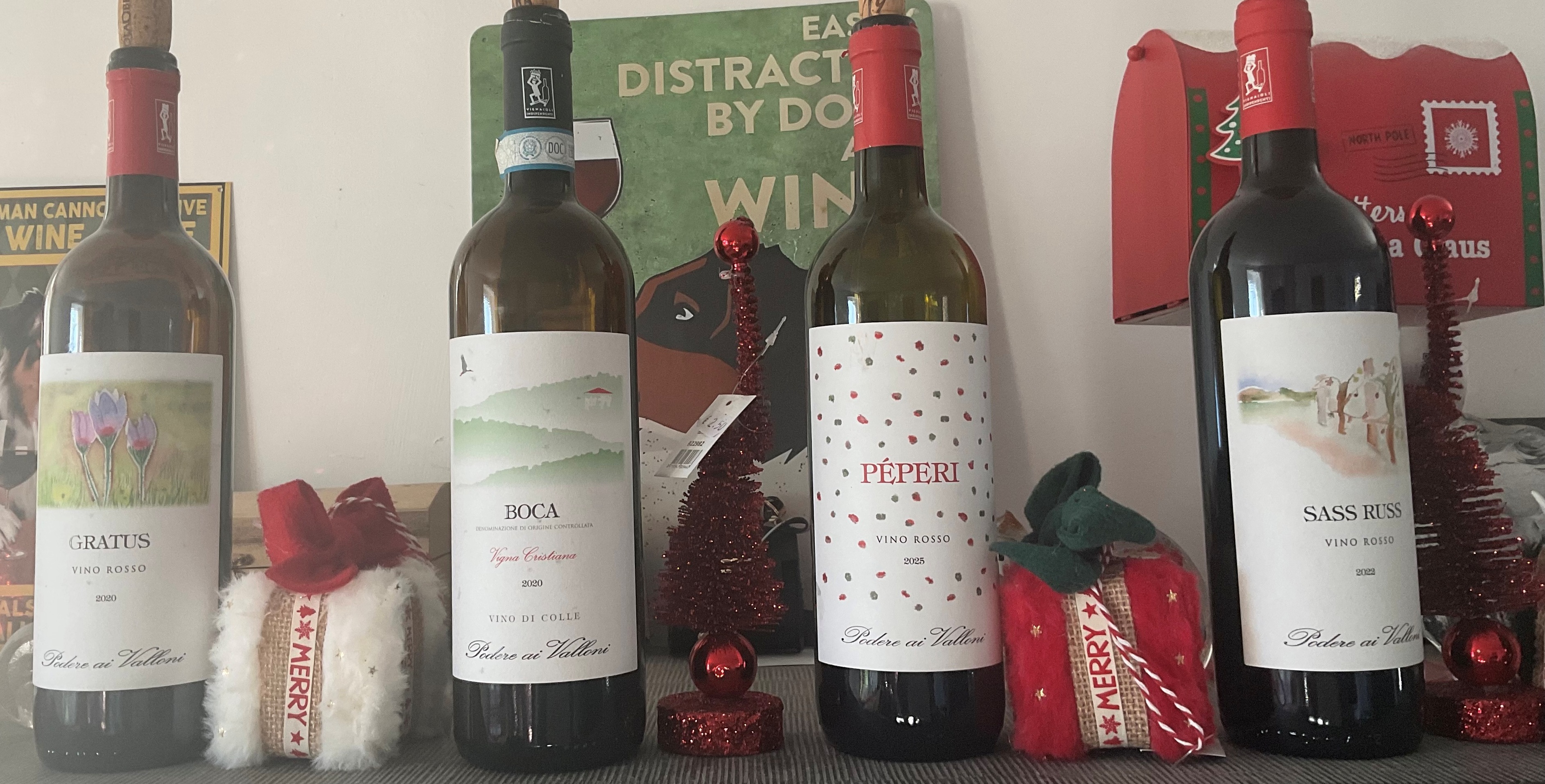
Boca
The grape varieties used for “Boca” and “Boca” Riserva must consist of 70 to 90% Nebbiolo (Spanna) in the blend, with the remaining 10 to 30% made up of Vespolina, Uva Rara (Bonarda novarese), or a blend of these two varieties.
APPELLATION REGION The area around the town of Boca and parts of Maggiora, Cavallirio, Prato Sesia, and Grignasco.
SOIL The distinctive characteristics of this wine are due to the soil profile, which consists mainly of volcanic rock (porphyry, tuff) formed by the eruption of a supervolcano in Valsesia (approximately 280 million years ago). The more superficial soil layers cover these rocks only in small patches in the lower-lying parts of the hills. These layers consist of clay, sand, granite boulders, porphyry, and rock sediments from Mount Fenera and vary in density depending on the location. The porphyry is bare and brittle, with colors ranging from pink to purple and from yellow to mustard.
WINE COLOR: ruby red with garnet hues. Nose: typical, delicate, and ethereal. Palate: dry, savory, harmonious, and fairly tannic.
AGING: “Boca” 34 months, 18 of which in wooden barrels. “Boca” Riserva 46 months, 24 of which in wooden barrels.
This wine has very ancient origins: as early as 1300, the chronicler Pietro Azario of Novara wrote that this wine had been “famous since ancient times.” Furthermore, there is ample evidence that Boca wine was supplied to the Spanish army as it advanced from Piedmont toward Lombardy to occupy that region.
The unique soil of the hills where the vineyards grow provides the ancient Nebbiolo grape variety, as well as two other grape varieties typical of these hills that complement each other: Bonarda Novarese and Vespolina, an ideal environment for them to thrive. The DOC Boca appellation was established in 1969.
BRAMATERA
Bramaterra wine comes from the area comprising seven villages on the hills above Baragge, a region sheltered by Monte Rosa. It appears that this wine originated with freed serfs who decided to settle in this area and begin growing grapes, from which they could produce a highly prestigious wine.
The first recorded mention of the name “Bramaterra” appears on a parchment from 1447, and it seems the meaning of the name is linked to the affinity and agricultural suitability of this land. The DOC appellation was established in 1969. Bramaterra was also known as “the wine of the canons,” as it was particularly prized by the curia in Vercelli.
The grape varieties used for “Bramaterra” and “Bramaterra” Riserva must consist of 50 to 80% Nebbiolo (Spanna) in the blend, up to 30% Croatina, and up to 20% Vespolina, Uva Rara (Bonarda novarese), or a blend of these two varieties.
APPELLATION REGION The area surrounding the towns of Masserano, Brusnengo, Curino, Roasio, Villa del Bosco, Sostegno, and Lozzolo, all located on the hills north of State Route 142.
SOIL The soil ranges from volcanic types, originating from the eruption of a supervolcano in Valsesia (approximately 280 million years ago), to marine sand from the Pliocene epoch (approximately 4 million years ago). The soil consists of sediments formed by the fragmentation of porphyry, along with a more superficial layer of sand. In the northern parts of the appellation, there is primarily marine sand, while in the southern part of the region there are also carbonate and limestone rocks, which are quite unique to the wine-growing areas of Alto Piemonte.
WINE COLOR: garnet red with orange hues. Nose: typical, intense, slightly ethereal, which enhances the finesse during aging. Palate: dry and full-bodied, velvety smooth with a balanced bitter undertone, harmonious with good structure. Aging: “Bramaterra” 22 months, 18 of which in wooden barrels. “Bramaterra” Riserva: 34 months, 24 of which in wooden barrels.
COLLINESE NOVARESI
The “Colline Novaresi” appellation, which does not specify the grape variety used to make the wine, can include both red and white wines. The red wine is made with at least 50% Nebbiolo, while the white wine is produced with 100% Erbaluce grapes. The “Colline Novaresi” appellation followed by the name of the grape variety indicates that the wine contains at least 85% of that variety.
REGIONAL APPELLATIONS: Barengo, Boca, Bogogno, Borgomanero, Briona, Cavaglietto, Cavaglio d’Agogna, Cavallirio, Cressa, Cureggio, Fara Novarese, Fontaneto d’Agogna, Gattico, Ghemme, Grignasco, Maggiora, Marano Ticino, Mezzomerico, Oleggio, Prato Sesia, Romagnano Sesia, Sizzano, Suno, Vaprio d’Agogna, Veruno, and Agrate Conturbia.
SOIL The soil is morainic and alluvial, characterized by a higher content of silt and clay on the northern side of the region, while on the southern side it has a loose structure. The richness and vigor of the local grape varieties are also reflected in the various pruning systems used, which give the hills of this area a unique profile.
WINE COLOR: ranging from bright yellow to a spectrum of lighter and darker shades of red, depending on the grape variety. Nose: fragrant and delicate for white wine; fruity and delicate for Novello; intense, fresh, fruity, and mineral for the other wines belonging to this appellation. Palate: dry and full-bodied, velvety smooth with a balanced hint of bitterness, harmonious with good structure.
AGING: Not specified.
This DOC appellation, established in 1994, includes various wine varieties, such as Nebbiolo, Vespolina, Croatina, and Bianco. The production area lies among the hills of the two valleys through which the Ticino and Sesia rivers flow, a place where grapes have been cultivated since pre-Roman times.
Coste della Sesia This appellation was established in 1996, and the region lies between the two rivers, the Dora Baltea and the Sesia, where the landscape is breathtaking.
COSTE DELLA SESIA
This appellation was established in 1996, and the region lies between the two rivers, the Dora Baltea and the Sesia, where the landscape is breathtaking.
The “Coste della Sesia” appellation, which does not specify the grape variety used to make the wine, can produce red, rosé, or white wines. The red and rosé wines are made with at least 50% Nebbiolo, while the white wine is produced with 100% Erbaluce grapes. The “Coste della Sesia” appellation followed by the name of the grape variety indicates that the wine contains at least 85% of that variety: “Coste della Sesia” Nebbiolo or Spanna; “Coste della Sesia” Croatina; “Coste della Sesia” Vespolina.
REGIONAL APPELLATIONS: Gattinara, Roasio, Lozzolo, Serravalle Sesia, located in the province of Vercelli. Lessona, Masserano, Brusnengo, Curino, Villa del Bosco, Sostegno, Cossato, Mottalciata, Candelo, Quarenga, Cerreto Castello, Valdengo, and Vigliano Biellese, located in the province of Biella.
SOIL The area is diverse and characterized by varying climatic, soil, and morphological conditions. The soil has various profiles, ranging from clay to sand, granite gravel, and porphyry. This heterogeneity is evident throughout the region and in the two provinces that make up the appellation: Vercelli and Biella.
WINE COLOR: bright yellow for white wine; brighter or softer pink for rosé wine; brighter or softer red for the other wines; garnet red with orange hues for the Nebbiolo or Spanna Coste della Sesia appellation when aged. Nose: characteristic, refined, and intense for the white wine; delicate for the rosé wine; refined, persistent, and characteristic for the other wines. Palate: dry and balanced for white and rosé wines; dry, characteristic, full-bodied, juicy, balanced, sometimes lively, and fairly tannic for the other wines.
FARA
The grape varieties used for “Fara” or “Fara” Riserva must consist of 50 to 70% Nebbiolo (Spanna) in the blend, and the remaining 30 to 50% of the blend must consist of Vespolina, Uva Rara (Bonarda novarese), or a blend of these two varieties. Other non-aromatic red grape varieties from suitable vineyards in Piedmont may make up to 10% of the blend.
APPELLATION REGION The area around the towns of Fara and Briona.
SOIL The vineyards are located on the eastern side of the Sesia Valley, on a long, gentle slope running from north to south: a plateau consisting mainly of clay and divided into two slopes. The hills were formed from alluvial and glacial deposits dating back to the Pleistocene (approximately 400,000 years ago), resulting in a heterogeneous and layered soil structure. At the top of the plateau, the soil is deep and clayey; on the western slopes, it is loose and rich in pebbles, with a layer of gravel deeper down.
WINE COLOR: ruby red. Nose: delicate and pleasant. Palate: dry, juicy, and harmonious.
AGING “Fara” 22 months, 12 of which in wooden barrels. “Fara” Riserva 34 months, 20 of which in wooden barrels. Fara wine was highly prized by abbots, bishops, and lords who, during the Middle Ages, cultivated grapes not only for religious purposes but also to generate income through the sale of the product, thereby supporting the church community.
Although the percentage of Nebbiolo used in this blend is lower than in the other appellations in the region, Fara is highly regarded by wine connoisseurs as a wine that should be tasted “immediately” and “with attention.” The DOC appellation was established in 1969.
GATTINARA
“A sip of Gattinara. Only if it’s the real thing—that goes without saying—that’s all I ask!” These are the words Mario Soldati wrote in one of his short stories about his beloved places in Piedmont. Gattinara has ancient origins; the vineyards were planted by the Romans in the 2nd century B.C. It is also believed that the town of Gattinara was built on the site where the proconsul Quinto Lutazio Catulo offered the spoils of the Cimbrian War—in which the Cimbri were defeated near Vercelli in the summer of 101 B.C.—to the gods. It was here that the “Catuli Ara,” the altar of Catulo, was erected, from which both the town and the wine derive their names. Several centuries later, in 1518, Cardinal Mercurino Arborio, Marquis of Gattinara and chancellor to Charles V, introduced the wine to the court of the King of Spain, thereby making it known to the European nobility. The DOCG designation was established in 1990.
The grape varieties used for “Gattinara” and “Gattinara” Riserva must consist of 90 to 100% Nebbiolo (Spanna), with a maximum of 4% Vespolina and a maximum of 4% Uva Rara (Bonarda Novarese), provided that the combination of Vespolina and Uva Rara does not exceed 10% of the blend.
APPELLATION REGION The area surrounding the town of Gattinara. SOIL The bedrock consists primarily of porphyry-ignimbrite, formed by the eruption of a supervolcano in Valsesia (approximately 280 million years ago). The more superficial soil layers cover these rocks only in small patches in the lower parts of the hills. The soil is derived directly from the fragmentation of the underlying rocks. The vineyards are primarily located on very steep slopes, where the soil is very hard and compact, yet brittle only on the surface.
WINE COLOR: garnet red with light orange hues. Nose: delicate, pleasant, and spicy with soft hints of violets.
TASTE: dry, harmonious, with a characteristic bitter undertone.
AGING: “Gattinara” 35 months, 24 of which in wooden barrels. “Gattinara” Riserva 47 months, 36 of which in wooden barrels.
GHEMME
The grape varieties used for “Ghemme” and “Ghemme Riserva” must consist of 85 to 100% Nebbiolo (Spanna) in the blend, and up to 15% Vespolina, Uva Rara (Bonarda novarese), or a blend of these two varieties.
APPELLATION AREA The area around the town of Ghemme and parts of Romagnano Sesia. SOIL The hills in
Ghemme consist of alluvial and glacial deposits from the Pleistocene epoch (400,000 years ago). These are not moraine formations, but deposits formed by the melting of ancient glaciers in the area north of Borgosesia. The soils lie directly above these deposits, consisting of rocks and sediments of various origins, with a surface layer composed of clay, kaolin, and tuff. On the plateau, the soil is more compact and deeper; on the western slope, it is loose and contains pebbles. The soil is rich in dissolved minerals, which are absorbed by the vines and give the grapes their characteristic juicy flavor.
WINE COLOR: ruby red with garnet hues.
NOSE: characteristic, delicate, pleasant, and ethereal. PALATE: dry, juicy, with a harmonious hint of bitterness, well-balanced.
AGING: “Ghemme” 34 months, 18 of which in wooden barrels. “Ghemme” Riserva: 46 months, 24 of which in wooden barrels. This is a historic wine from Piedmont whose origins date back to the 4th–5th centuries B.C., produced on the hills formed by the melting of an Alpine glacier. It is said that during Roman times, the production of this wine was so extensive that Agamium—now the town of Ghemme—was represented by a symbol featuring a bunch of grapes and a sheaf of wheat. It was praised by Fogazzaro in “Piccolo mondo antico” (Ghemme was the wine served at gala banquets).
LESSONA
Quintino Sella, a prominent leader and minister, toasted the establishment of Italy’s first unified government with this wine. More than a century later, in 1976, the majesty of this wine was recognized with the establishment of the DOC appellation.
APPELLATION REGION The area surrounding the town of Lessona.
The grape varieties used for “Lessona” and “Lessona” Riserva must consist of 85 to 100% Nebbiolo (Spanna) in the blend, and up to 15% Vespolina, Uva Rara (Bonarda novarese), or a blend of these two varieties.
SOIL From a geological perspective, Lessona is an area composed of marine sediments resting on deep porphyry bedrock. There is a significant amount of Pliocene sand present. The vineyards are located at an average elevation of 350 meters above sea level, and the climate is predominantly mild. In this area as well, Monte Rosa helps protect the vineyards from the cold north wind, but it also causes a significant temperature difference between day and night. The soil is predominantly acidic and rich in iron, potassium, and magnesium, with a magmatic component determined by the porphyry. Fossilized shells can be found here.
WINE COLOR: garnet red with orange hues when aged.
NOSE: characteristic, with hints of violets; intense and delicate. PALATE: dry, fairly tannic, characteristically juicy and pleasant, with a lingering finish.
AGING: “Lessona” 22 months, 12 of which in wooden barrels. “Lessona” Riserva 46 months, 30 of which in wooden barrels.
SIZZANO
The grape varieties used for “Sizzano” and “Sizzano Riserva” must consist of 50 to 70% Nebbiolo (Spanna) and 30 to 50% Vespolina, Uva Rara (Bonarda novarese), or a blend of these two varieties.
Other non-aromatic red grape varieties, sourced from suitable vineyards in Piedmont, may make up to 10% of the blend.
APPELLATION REGION The area surrounding the town of Sizzano.
SOIL The vineyards are located on the eastern side of the Sesia Valley, on a long, gentle slope running from north to south: a plateau consisting mainly of clay and divided into two slopes. The hills were formed from alluvial and glacial deposits dating back to the Pleistocene (approximately 400,000 years ago), resulting in a heterogeneous and layered soil structure. At the top of the plateau, the soil is deep and clayey; on the western slopes, it is loose and rich in pebbles, with a layer of gravel deeper down.
WINE COLOR: ruby red with garnet hues.
NOSE: vinous, characteristic, with light hints of violets; delicate and pleasant. PALATE: dry, fairly tannic, characteristically juicy and pleasant, with a lingering finish.
AGING: “Sizzano” for 22 months, 16 of which are in wooden barrels.
VALLI OSSELANE
Winegrowing also has deep roots in this area, dating back to the time when the first settlements were established in this valley. Prunent (Nebbiolo) has been cultivated here for over 700 years. The first mention of the name Ossola comes from the geographer Ptolemy (2nd century AD), who refers to “Oskela Leopontion,” alluding to the local Leponzi people.
The DOC appellation was established in 2009 and is the youngest of all appellations in this region. The appellation “Valli Ossolane” followed by “Bianco” means that the wine contains at least 60% Chardonnay and no more than 40% non-aromatic white grape varieties, produced in suitable vineyards in Piedmont. The “Valli Ossolane” appellation followed by “Rosso” means that the wine contains at least 60% Nebbiolo, Croatina, Merlot, or a blend of these varieties, and no more than 40% non-aromatic red grape varieties, produced in suitable vineyards in Piedmont. The designation “Valli Ossolane” followed by “Nebbiolo” and “Nebbiolo Superiore” means that the wine contains at least 85% Nebbiolo and no more than 15% non-aromatic red grape varieties, produced in eligible vineyards in Piedmont. APPELLATIEREGIO Beura Cardezza, Bognanco, Crevoladossola, Crodo, Domodossola, Masera, Montecrestese, Montescheno, Pallanzeno, Piedimulera, Pieve Vergonte, Premosello, Ornavasso, Trontano, Viganella, Villadossola, Vogogna.
SOIL The soil is heterogeneous and of glacial origin. It consists of a complex of moraine hills formed by the melting of various geological formations and the subsequent erosion and fragmentation caused by alluvial and glacial flows. On the hills, the soil has been reorganized through the use of terraces. The soil is moderately deep and has a good gravelly structure that is ideal for drainage. At lower elevations, there are also deeper soils, with a range of textures from sandy loam to clay loam.
WINE COLOR: intense ruby red with garnet hues. Nose: vinous and intense. Palate: dry, harmonious.
AGING: “Valli Ossolane Nebbiolo Superiore” 13 months, 6 of which are in wooden barrels.
Welcome to our Masterclasses!
Comments
Login to give reaction Your comment will be posted as soon as it is approved.