


Timorasso, the white phoenix of Piedmont!
Timorasso is one of the most fascinating stories in the modern Italian wine world. It is the story of a native grape variety that had nearly disappeared but was brought back to prominence thanks to a few determined winemakers, and today produces wines that can rival great white wines meant for aging. Timorasso is the future of Derthona
Timorasso (the grape), Derthona (the geographical and historical wine identity), and Colli Tortonesi (the designation of origin) mustbe clearly distinguished from one another.
The identity of Timorasso
Derthona identity: dry, structured, fresh, powerful, and food-friendly; aging potential is 5 to 10 years
Timorasso is not one of the distinctly aromatic grapes like Moscato or Gewürztraminer. The grape derives its character from a combination of acidity, extract, texture, and aromatic development during bottle aging.
That is what makes it particularly interesting. A young Timorasso and the same wine after ten years can offer two very different experiences.
History: From Regional Pride to Near Extinction
1. 1833–1834 — Early written records
In 1833, grapevines were planted in Monleale under the name Temorasi. In 1834, botanist Giorgio Gallesio described the grape in the vicinity of Novi Ligure.
2. 1875 — A major regional grape
In the *Ampelografia della Provincia di Alessandria*, Demaria and Leardi provide a detailed description of Timorasso. At that time, it accounted for about a quarter of the area planted with white grapes in the Tortona region.
3. Late 19th century — Exports from Tortona
Young wines, sometimes still fermenting, were transported by train to Lombardy, Switzerland, and Germany. Locally, they were called turbolini or virginén.
4. 20th century — Dramatic decline
The effects of phylloxera, changing agricultural practices, rural depopulation, and a preference for more productive varieties undermined cultivation. In the 1960s, production still amounted to approximately 14,000 hectoliters.
5. 1980s — On the Brink of Extinction
By the end of the decade, according to the Italian research institute CNR, just over two hectares remained. Some historical reconstructions even suggest that by 1985, only half a hectare remained.
6. From the 1980sOnward — Walter Massa and the Revival
Walter Massa from Monleale saw the potential for high-quality dry white wines, rather than judging the grape by its limited yield.
7. 2000–2025 — New Growth
From approximately 19 hectares around the year 2000, Timorasso once again developed into an important regional specialty. According to a publication by Decanter, the planted area in 2025 was approximately 500 hectares.
Historical data from CNR, the Italian Vitis Database, and Decanter. The figures refer to different survey years and, in some cases, different delineations.
Why Did Timorasso Nearly Disappear?
The decline was not the result of a single event.
Economic factors: Timorasso was more difficult to grow profitably than high-yielding alternatives. In the postwar period, winegrowers were primarily in need of predictable yields.
Agronomic factors: The grape can experience problems during flowering and fruit set. This sometimes results in irregular clusters and highly variable yields.
Demographic factors: As a result of industrialization, many farming families left the countryside. Labor-intensive vineyards were abandoned or replaced.
Commercial factors: Piedmont was internationally renowned for its red wines, particularly Barolo and Barbaresco. A complex white wine from Tortona had hardly any established market.
An interesting journalistic fact is that the qualities that make Timorasso appealing today—concentration, structure, and long aging potential—did not yield sufficient economic benefits at the time.
Walter Massa: the man who gave the grape a second life!
The winemaker from Monleale is considered the central figure behind the modern revival of Timorasso.
His family business, Vigneti Massa, has roots dating back to 1879. Starting in the 1970s, he further developed the family business and went against the prevailing commercial logic.
His key insight was that Timorasso should not be treated as a simple, easy-drinking white wine.
Massa understood that the combination of natural acidity, structure, and aromatic complexity could produce a wine that would improve over the years.
His approach centered on meticulous vineyard management, harnessing the grape’s aging potential, and forging a distinct identity for the region.
An important point for your editorial: Walter Massa didn’t just save a grape variety; he helped give an entire wine region a new identity.
The terroir: the Colli Tortonesi
The Colli Tortonesi are located in the far southeast of Piedmont, in the province of Alessandria. The region lies at the crossroads of four major geographical influences: Piedmont, Lombardy, Liguria, and Emilia-Romagna.
It is not a continuous expanse of vineyards, but a varied landscape of hills, forests, fields, orchards, and small villages.
Soil and Geology
The region features a variety of soils, including:
• Calcareous marl, including the well-known Marne di Sant’Agata Fossili.
• Clay , which affects water retention capacity.
• Sandy deposits on certain slopes.
• Marine sediments that bear witness to the area’s geological history.
The calcareous and clay-rich marls are often associated with the structure and aging potential of the wines. However, from a scientific standpoint, it is more prudent to describe minerality in wine as a sensory impression, rather than as a direct flavor derived from soil minerals.
Climate
The climate combines continental and Apennine influences. Warm summer days promote ripening, while cooler nights, variations in elevation, and the orientation of the slopes can help preserve acidity.
For a good Timorasso, this balance is essential: sufficient ripeness for concentration, but enough freshness to avoid a heavy, ponderous wine.
The official regional organization describes the Colli Tortonesi as an area comprising 46 municipalities, with approximately 1,250 hectares of vineyards within the DOC. That figure includes all grape varieties combined, not just Timorasso.
The Grape Itself: Ampelography and Viticulture
Botanical characteristics
Characteristic Description
Leaf Medium-sized , often three- or five-lobed
Cluster Medium to large, pyramidal, often winged
Compactness Moderately compact to compact
Berry Medium-sized , round to slightly elliptical
Color Yellow-green when ripe
Skin With a natural waxy coating (pruina)
Ripening:Often around mid-September, depending on the season and plot
Productivity Variable , prone to irregular fruit set
The challenge for the winegrower
Timorasso is not an easy grape to grow.
Two key issues are:
Coulure (flower or fruit drop): some of the flowers fail to develop into full-sized grapes, resulting in a reduced yield.
Millerandage: within the same cluster, berries of unequal size develop, sometimes with incompletely developed seeds.
These phenomena can lead to a smaller and less predictable harvest. They make cultivation more economically risky, but also explain why the grape is not well-suited for large-scale, low-cost wine production.
What does Timorasso taste like?
Sensory development is one of the strongest topics for an editorial article.
Young Timorasso — about 1 to 3 years
Citrus, lemon zest, green and yellow apple, pear, white flowers, sometimes peach and fresh herbs. The wine often has pronounced acidity, a firm structure, and a long, savory finish.
Aged Timorasso — approximately 4 to 8 years
Ripe stone fruit, dried citrus, honey, almond, hazelnut, herbs, and sometimes a slight waxy note. The acidity remains present but is generally better integrated.
Older Timorasso — 10 years and older
In well-aged wines, notes of dried apricot, beeswax, honey, nuts, dried herbs, and sometimes petroleum-like nuances may emerge. The wine can become remarkably complex and layered.
The exact development depends heavily on the producer, vintage, winemaking, and storage conditions. Not every Timorasso is meant to be aged for fifteen years.
Why does Timorasso age so well?
The grape combines several favorable characteristics:
1. Generally robust naturalacidity .
2. Arelatively high level of extract and a pronounced mouthfeel.
3. Sufficient alcohol and concentration when fully ripe.
4. Aromatic precursors that can yield new aromas during aging.
A particularly interesting scientific aspect is the presence of norisoprenoids, a group of aromatic compounds that can play an important role in the development of aged wine, among other things.
The Italian CNR describes Timorasso as low in terpene aromas but rich in norisoprenoids. This helps explain why the grape tends to develop complexity during aging rather than an exuberant bouquet in its youth.
Derthona: Much More Than Just Another Name
The name Derthona refers to the ancient Roman name for Tortona.
The use of this name has strategic significance: producers want consumers to recognize not only a grape variety but also a region of origin.
The comparison with Barolo is interesting. Barolo is a geographical wine identity, while Nebbiolo is the grape variety. In Tortona, efforts are being made to develop a similar level of recognition around Derthona and Timorasso.
That does not mean that Derthona and Barolo are legally or commercially equivalent. It is about the principle of a wine becoming known by its geographical identity.
How is Timorasso vinified?
Timorasso does not necessarily require new oak to become a full-bodied wine. This is a key difference from the popular perception of rich white wines, where full-bodiedness is often automatically associated with oak aging.
The grape’s natural structure alone can provide an impressive mouthfeel.
Food Pairing with Timorasso
Risotto with porcini mushrooms
The earthy flavors of the mushrooms pair beautifully with the texture and riper aromas of Timorasso.
Vitello tonnato
A classic Piedmontese pairing where the wine’s acidity complements the creamy tuna sauce.
Turbot or sea bass
Richer preparations—especially those with butter, herbs, or a creamy sauce—pair well with a full-bodied Timorasso.
Aged Piedmontese cheeses
Think of Castelmagno, Toma, and certain aged Robiolas, depending on the wine’s intensity.
The Future: From a Saved Grape Variety to an Established Wine Region
The question is no longer simply whether Timorasso can survive. The challenge is how the region can continue to grow without losing its character.
• Climate change : How can winemakers maintain sufficient acidity and aromatic finesse during warmer growing seasons?
• New investors: How does interest from large wineries affect small family-run businesses?
• Origin identity : Will Derthona become a recognizable name for consumers, independent of the grape variety?
• Quality and price: Can Timorasso evolve into an established category of great white wines suitable for aging on the international stage?
A recent Decanter article highlights that young winemakers and new companies are actively contributing to the further development of Derthona.
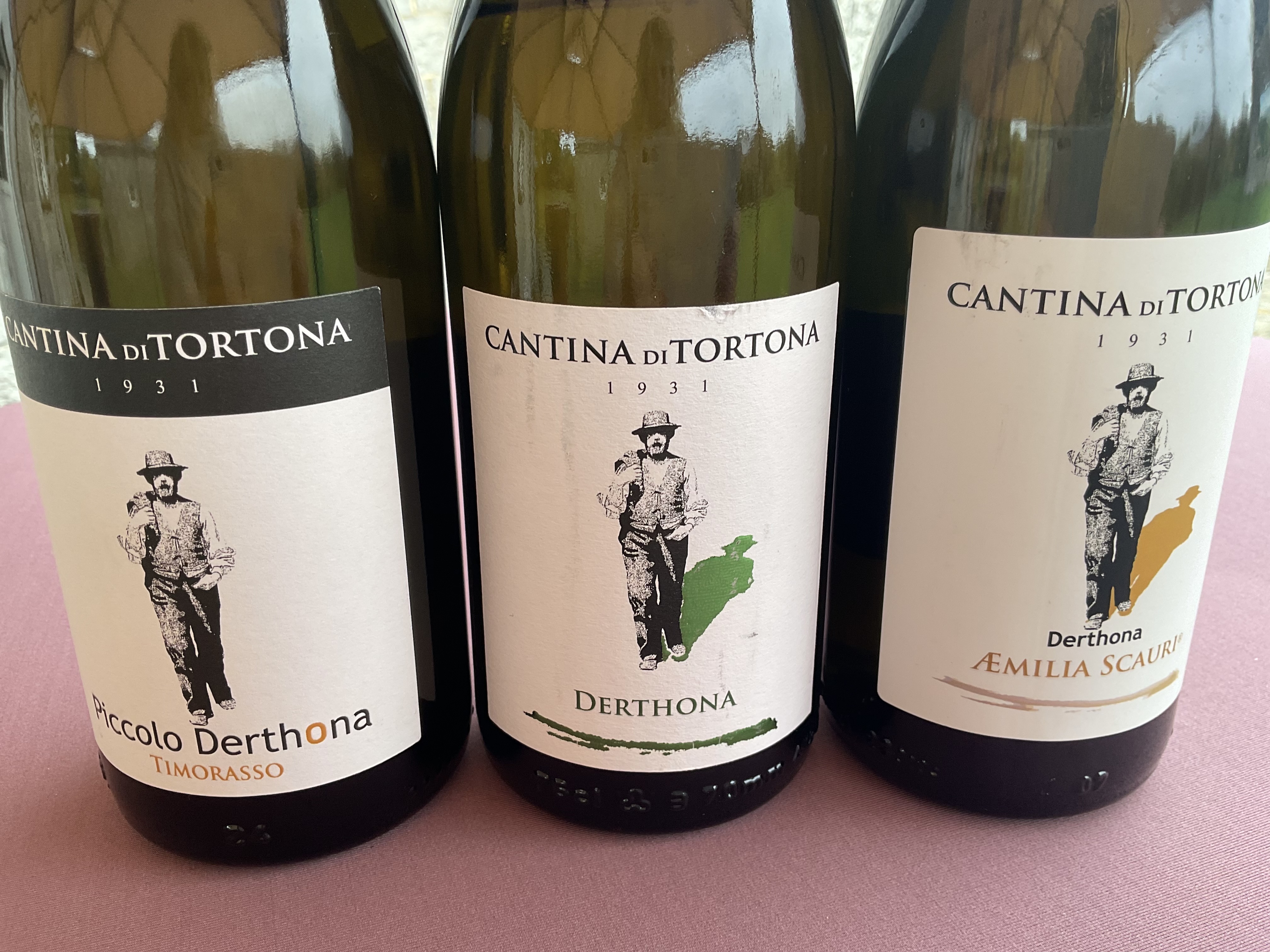
After comparing the market and selecting from a group of my colleagues at the Associazione Italia Sommelier (Turin), the top Timorasso from Made In Piedmont isCantina di Tortona, Timorasso, Aemelia Scauri! Stay tuned—two more slightly more budget-friendly wines from this winery will be available online soon.
We’ve also discovered a brand-new, prestigious winery: Sassaia, Derthona, Colli Tortonesi, Timorasso! We’ve already held a tasting with Belgium’s top wine journalist! Coming online very soon!
Comments
Login to give reaction Your comment will be posted as soon as it is approved.